Abstract.
My name is Galiwango Nicholus John. But sometimes I wish my name was ‘Rosa Parks’. Rosa parks was a 42 year old woman in 1955. In a racially segregated Montgomery, Alabama that through her simple act of refusing to move to the back of the bus catalysed the civil rights movement in America. But unfortunately I am a man. A black man in a racially integrated Britain. Sometimes I stay up all night and wonder if I’ll ever bring on a change like Rosa Parks did. A lasting change like Rosa Parks that she led from behind. Heterosexual monogamy with a doctorate in philosophy is my only core value. But it’s my vision of Rosa Parks that I struggle with because am in a world that is not only already integrated but is saturated with technology. A world where people are now paying more and more attention to Instagram, whatsapp and facebook and less and less on real social change. Real social change like environmental conservation or eradication of diseases and poverty. Social change has willingly gone to the back of the bus while technology is taking a front seat in this world. Where real human connection doesn’t matter if you have one million followers on twitter. Rosa Parks is unlike me because she was in a different world than I am in now. She was in a segregated world of a different kind.
Introduction.
Any leader in 2019 is a leader like me because we are facing the same challenges today and like all challenges they can either be overcome or not. To overcome these challenges I have chosen the theory of power and influence by well known, “social psychologists John. R.P. French and Bertram Raven (1959)”. (Janzen 2018). According to French and Raven there are five types of power as seen in the diagram below 😦 Mullins 2016: 330)
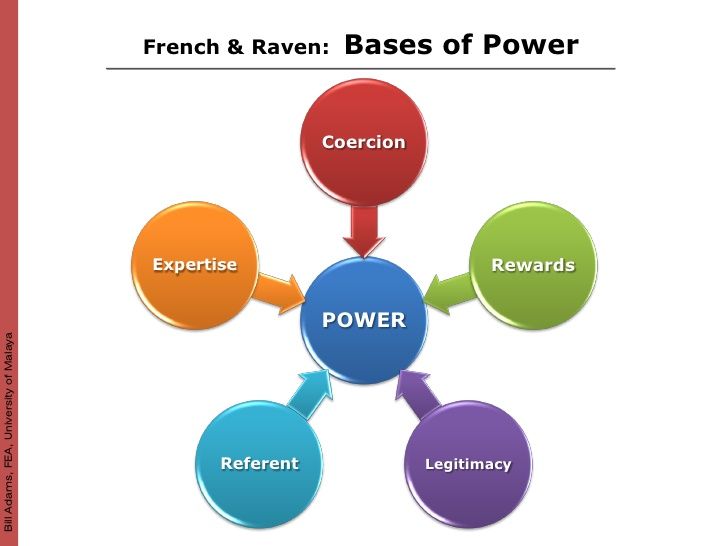
Source: French and Raven (1968)
Legitimate power
Legitimate power is power that comes from one’s organizational role or position (Martin 2018). For example, my seminar lecturer Dr Ian King assigned each member of our group a week to be a leader and during that when each member was a leader they had the power to call for a group meeting.
Reward power
Reward power is the ability to give a reward. The reward granted can be either tangible or intangible (Martin 2018). For example during my week as a leader I gave my group members an intangible reward of praise where I thanked them for all their hard work. An example of tangible reward would be like a pay raise in an organisation.
Coercive power
This type of power usually involves a person in power punishing a subordinate. Coercive power typically works through one person being in a position of power over another person (Martin 2018). For example during my days as a banking officer in my home country our branch manager once embarrassed another banking officer by making her come in front of the whole branch staff during a staff meeting and explain to us all something embarrassing she had done to a customer. She, the banking officer cried in front of all of us at the branch while she was explaining the embarrassing incident.
Expert power
This power usually comes from the ability to influence others basing on knowledge and skill. Any member of an organization who has specialized knowledge or skill may have expert power (Martin, 2018). For example ‘Rosa Parks had expert power in 1955 through her strong friendship ties and weak friendship ties she had attained in the black community of Albama. She was a part of so many groups in her black community that included the NAACP (National Association for the Advancement of Colored People), Methodist church group, she used to volunteer at her local shelter, botanical club and a group of women who used to knit blankets for a local hospital. So when she was arrested in 1955 those strong and weak friendship ties she had throughout the black community led to one of the first of the many boycotts of the civil rights movement. The bus boycott.
Referent power
This type of power is the ability for the leader to influence the follower (Martin, 2018). This usually stems from a person’s personal characteristics like charisma. For example Martin Luther King, another important and noble peace prize winner of the civil rights movement. Martin Luther king inspired a whole nation with his charismatic speech of ‘I HAVE A DREAM’.
Conclusion
Of the five types of power Charisma and Expert power are my favourite. And even if future leaders might need a combination of all, across breed between Martin Luther King and Rosa parks I think would produce the perfect leader. If I was the cross breed child of King and Rosa I would refuse for real social change like environmental conservation or eradication of diseases and poverty to take the back seat for a world where people are now paying more and more attention to Instagram, whatsapp and facebook. I would have the expert power (strong and weak friendship ties) and THE DREAM to ensure the recycling of waste materials actually works instead of first world countries dumping their waste in developing countries like Malaysia. I would be the expert Bill Gates hires to solve the energy crisis by discovering new and clean renewable energy sources and I would advocate for global heterosexual marriages where spouses never cheat on each other to completely eradicate HIV.
References
- Jazen, M.E. (2018) ‘Power and influence theory’. [online] available from https://wikispaces.psu.edu/pages/viewpage.action?pageId=364286653 [2 December 2019]
- Mullins, L.J. (2016) management and organisational behaviour. 11th ed. Edinburgh gate: Pearson.
- Martin, J. (2018). Unit 05: Influence tactics [online lecture]. Retrieved from https://psu.instructure.com/courses/1888899/pages/l05-influence-tactics?module_item_id=24602378 [2 December 2019]


 galiwann's blog
Interesting read especially the idea of the “cross breed child.”
LikeLike
Yes, please refer to the tv series “Doctor who” Season 11 episode 3, on BBC ONE.
LikeLike
Heya john, looking at your approach to the use of power and getting a positive result as a leader, i am sure that you are ready to face even bigger challenges in the future.
All the best.
LikeLike
Thank you but I have been an MBA student for a humble two months because I came 4weeks late but I hope to find ways of accelerating my learning processes.
LikeLike
Your blog is a motivational blog.I developed interest in this especially on area where you talked about how social change has been put to the back seat! This however, is why the issues of HIV eradication is of less important to the pharmaceutical sectors as they believed in making money than solving the endemic social problems .
LikeLike
Very true. A point of critical analysis yet to be further analysed in my next blog. Thank you.
LikeLike
Also a good blog especially the HIV eradication part.
LikeLike
Yes, but there is still a lot of room for improvement for an MBA student of only two months.
LikeLike